Choosing Between SPF30 and SPF50 for Global Markets
The two most common protection levels look closer than most labels suggest. Published figures put SPF30 at about 97% of UVB blocked and SPF50 at about 98%, so the decision is usually about setting and positioning rather than a large step in protection.

Key takeaways
- SPF30 blocks about 97% of UVB; SPF50 blocks about 98%.
- The gap is 1 percentage point, not a doubling of protection.
- SPF30 suits daily skincare and mass-market ranges, while SPF50 suits outdoor and high-UV settings.
- Tropical and high-UV markets often prefer SPF50, and the US frame adds SPF testing and labelling duties.
What the extra one percent actually buys
On paper the upgrade is small: 98 - 97 = 1 percentage point. In practice that point changes where a product can credibly sit. An SPF50 label is a promise about outdoor use and long exposure, and shelves in sunny markets are stocked around that promise. The difference matters most on a shelf where two similar products sit side by side and the buyer reads only the number on the front.
The SPF30 vs SPF50 choice is a market decision before it is a chemistry decision. A daily facial product competes on feel and texture, while an outdoor product competes on protection language. The same active system can serve both, but the brief around it is different, and that brief should name the setting before the formula is chosen.
Why SPF50 is not twice the protection of SPF30
The number on the bottle is not a straight multiplier of protection. SPF50 does not block twice the UVB that SPF30 blocks; it blocks about one point more. Reading the ratio in the way the label invites is the most common mistake in sunscreen planning, and it sets an expectation the measurement does not support.
What the higher level does buy is more headroom over a long day outdoors. When exposure is intense and continuous, the small difference in the share of UVB that reaches the skin matters more, especially if reapplication between the two is uneven. The stronger label helps, but it is no substitute for putting the product on again through the day. That is why the level is a labelling decision as much as a formulation one.
Where each level fits in global markets
Protection level tracks the setting where a product is sold. Daily skincare leans on SPF30, because the user wants a comfortable texture they will wear every morning. Outdoor and premium ranges lean on SPF50, because the buyer is paying for the stronger claim on the label. Price tends to follow the same logic, with the stronger claim usually holding a higher shelf position. A daily product and an outdoor product can share a factory and still need two different labels.
| Setting | Typical level | Reason |
|---|---|---|
| Daily facial skincare | SPF30 | Comfortable everyday texture |
| Mass-market ranges | SPF30 | Broad reach and value story |
| Outdoor activity | SPF50 | Long exposure and reapplication |
| Premium positioning | SPF50 | Stronger claim on the pack |
| Tropical, high-UV markets | SPF50 | Intense, year-round sun |
The table is a starting point, not a rule. A daily product in a very sunny country may still justify SPF50, and an outdoor product in a mild market may sell perfectly well at SPF30 if the rest of the offer is strong. Match the level to the market, and the rest of the offer can stay consistent across the range.
What changes for tropical and high-UV markets
Tropical and high-UV markets often expect SPF50, because buyers there know what a full day in the sun feels like. In those settings the premium claim is not a luxury, it is a baseline expectation, and an SPF30 label can read as underpowered next to it. A buyer in that market has learned to check the number before the brand story, so the number has to be right. Shelf position and label strength usually move together in those markets, so the figure carries real commercial weight.
UVA labelling travels with UVB labelling, so the pack usually carries both. The manufacturer's note on PA protection explains how the UVA side is marked, which is worth reading before a market-specific label is drafted. Getting the UVA and UVB marks right together matters, because the buyer reads them as one label.
Worked example: the residual UVB and the label gap
Read the two published figures as shares of UVB. SPF30 blocks about 97%, so 100 - 97 = 3% passes through. SPF50 blocks about 98%, so 100 - 98 = 2% passes. The residual falls from 3% to 2%, a 1-point drop, and measured against the SPF30 residual that is 1 / 3, about a one-third cut in the UVB that still reaches skin.
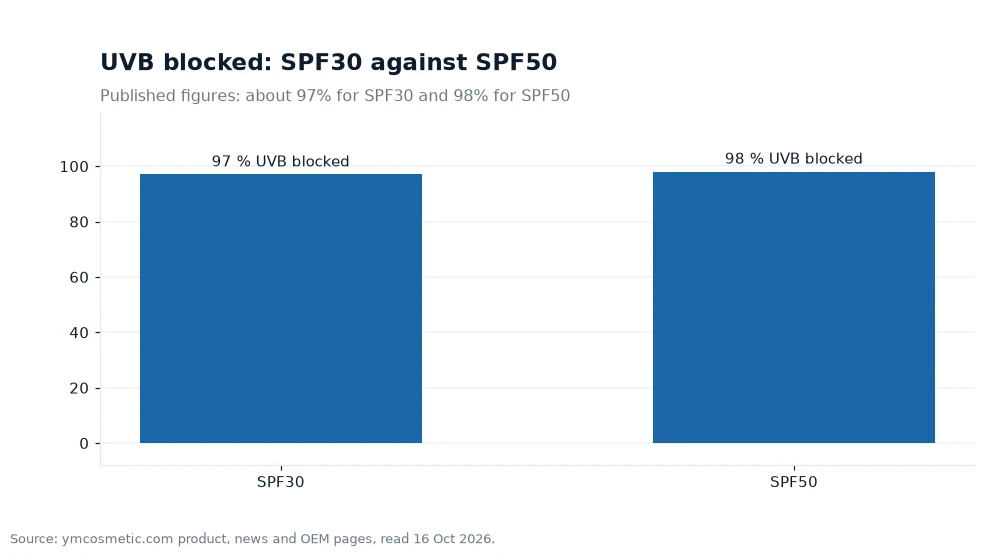
The two bars in the chart are nearly level, and that is the honest reading: the blocked share moves from 97 to 98. The more useful number is the small residual, 3% against 2%, because that is the slice that still reaches the skin and the slice the higher label reduces. Two bars that look level can still describe a real choice, because the label, not the bar, is what moves on the shelf.
Choosing the level per market before the formula
Decide the level market by market, then let the formula follow. Write down the setting, the target user and the claim the label must support, and the protection level usually chooses itself. This is where an OEM/ODM partner earns its keep, because one active system may need small changes between markets. A level chosen for the shelf is easier to defend than one chosen by habit, and deciding the level and the market together gives the formula one clear target to meet.
The United States adds its own frame, where sunscreen sits under the FDA sunscreen framework with approved active ingredients and defined SPF testing and labelling duties. Yunmei's sunscreen range shows how a single manufacturer presents products for more than one market and more than one level. Check the level and the market duties on the same sheet before the formula is locked.
Frequently asked questions
Is SPF50 much stronger than SPF30?
SPF50 blocks about 98% of UVB against about 97% for SPF30, so the measurable difference is one percentage point of the UVB share.
Which level should a new brand launch first?
A new brand can launch SPF30 for daily skincare and mass-market reach, and add SPF50 when it targets outdoor or high-UV settings.
Does the market change the level choice?
The market changes the level choice because tropical and high-UV markets often prefer SPF50, while daily skincare ranges commonly sit at SPF30.
Pick the level for the market, then build the product
Treat the protection level as a market question and the formula as the answer that follows. Read the two figures carefully, decide where each label will be sold, and the launch plan gets simpler. Write the level, the setting and the target user on one line so the whole team reads the same brief, then let the formula serve that single decision. For a closer look at how the levels sit side by side on real product pages, the sunscreen cream and spray page keeps the comparison in one place.
The capacity, quality and timing numbers shown above were read from the manufacturer's site on 16 Oct 2026.[1]